
The trench is a military design that never got redesigned, which is why it still works. Double breasted front, belted waist, storm flap across the shoulders, and a length that covers a suit jacket.
Everything sold as a trench that lacks the belt is really a long coat with a trench collar.

Gabardine, and why it matters
The original was cut from gabardine, a tightly woven cotton that sheds rain without the weight of a rubberised coat. A trench in a loose weave or a soft drape fabric looks the part and stops working the moment it actually rains.
Every detail had a job in the field
British officers wore these coats in the First World War, and the shape survives because each piece answered a problem. Storm flaps across the chest and shoulders shed water clear of the seams underneath. Epaulettes held rank insignia and stopped equipment straps sliding off the shoulder. Deep raglan sleeves let a man raise his arms without the whole coat riding up his back. Officers bought their own coats, so the design had to earn its keep.
Belt D-rings still appear on new coats, and nobody agrees on what they originally carried, so treat the popular explanations with suspicion. Better documented is the back yoke, a hanging cape that lets rain run off away from the body, and the vents under the arms that stop the coat turning into a sweat box on a long march. Modern versions keep all of it, because removing any piece leaves something that no longer looks like a trench.
Two seasons, one coat
Trenches were cut to go over a uniform, so there is room inside for a jacket or a heavy knit. That is the whole trick to wearing one from March through November. Thin knit and a shirt in spring, a blazer or a chunky cardigan in autumn, and a button-in liner, if the coat came with one, takes it into proper cold. Size it for the thickest thing you plan to wear underneath, not for a shirt.
Care is simple and mostly about patience. Let a wet coat dry on a broad hanger at room temperature, never on a radiator, since heat sets cotton into whatever shape it dried in. Dry clean rarely, because solvents strip the water repellent finish. Run the belt through its loops on the hanger instead of knotting it, and it stays flat. Stains come out far more easily the same week they happen than three months later.
| Detail | What it is | Why it exists |
|---|---|---|
| Storm flap | Extra panel across one shoulder | Ran rain off the chest |
| Epaulettes | Straps on the shoulders | Held rank insignia and kit |
| Belt with D-rings | Metal rings on the belt | Carried equipment in the field |
| Gun flap | Double layer at the upper back | Padding against a rifle butt |
| Storm cuffs | Buckled straps at the wrist | Sealed the sleeve against wind |
More trench coats to try on
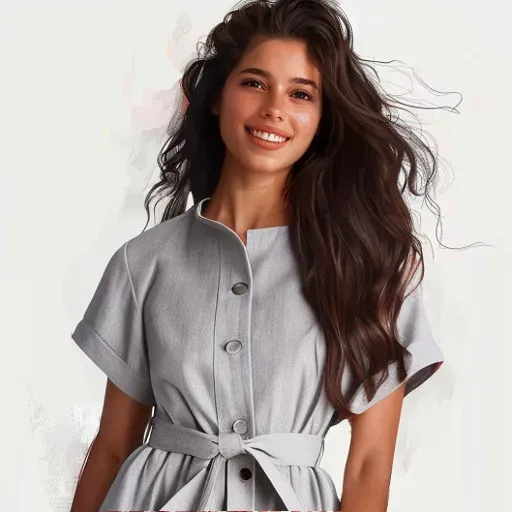 A light grey cotton blend duster coat
 Forest green
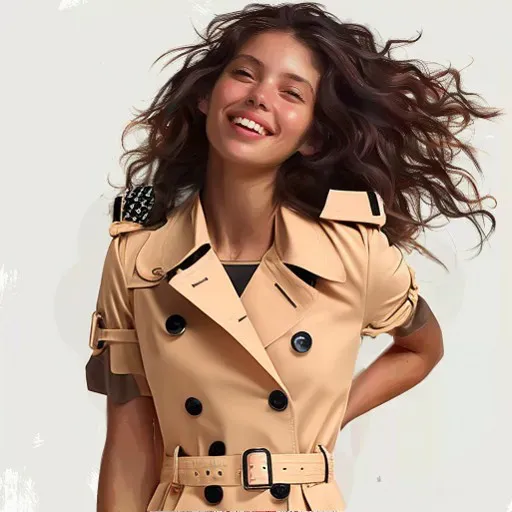 Classic beige cotton trench coat
 A black leather duster coat
 Charcoal grey
 Soft pastel pink
 Deep burgundy
 Electric blue
 A bright mustard yellow linen duster coat
 A classic beige wool duster coat
 An electric blue polyester duster coat
 Rich navy blue
Tap any look to open it in the app on your own photo.
Related
Peacoat vs Overcoat · Puffer Jackets · Blazers
Questions people actually ask
Should the trench belt be tied or buckled?
Tied at the back is the relaxed version and the one most people wear. Buckled at the front gives a sharper waist and a more formal read.
What length works best?
Just above or just below the knee. Mid thigh loses the proportion the design depends on.
Can a trench coat handle heavy rain?
For a while. Tightly woven cotton sheds a shower and soaks through in a sustained downpour, especially once the factory finish has worn down. It was built for weather, not for a monsoon. Reproofing sprays restore some of the repellency, and an umbrella covers the rest of it.
Does a trench coat work over a suit?
That is what the length is for. Proper trenches fall below the knee and cover a suit jacket completely, so nothing bunches or peeks out at the hem. Shorter versions that stop at mid-thigh look fine over jeans and leave a suit jacket half exposed underneath.